
 Image 1 of 1
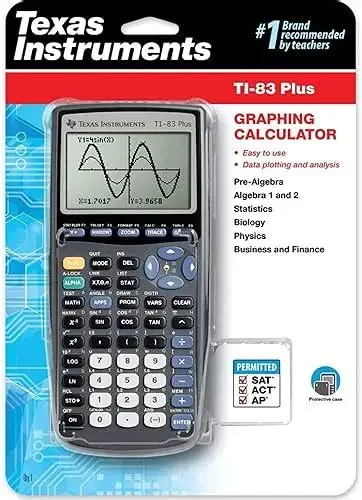
Texas Instruments TI-83 Plus Graphing Calculator
The Texas Instruments TI-83 Plus is a student-focused graphing calculator designed for algebra, geometry, precalculus, statistics, and standardized-test use. It balances functionality, ease of use, and exam acceptability, making it a common choice in classrooms and testing centers.
Key features of TI-83 Plus Calculator
Display: 96 × 64-pixel monochrome LCD, capable of plotting multiple functions, scatterplots, histograms, and simple graphics. Screen supports clear text and graph overlays but has no backlight (the used TI-84 Plus CE offers a full-color backlit screen).
Memory and storage: Approximately 160 KB of user-accessible archive memory for programs, lists, and variables, plus Flash ROM for operating system and additional applications. Memory allows storage of formulas, custom programs, and a modest number of apps.
Processor: Zilog Z80-compatible CPU providing responsive computation for algebraic manipulation, graphing, and statistical tasks.
Built-in functions: Standard scientific functions (trigonometry, logarithms, exponentials), matrix operations, complex numbers, polynomial root finding, numerical integration, derivatives, sequences, and probability distributions (binomial, normal, t, chi-square, etc.).
Graphing capabilities: Plot multiple functions simultaneously, adjust window settings, trace and evaluate points, find intersections, roots, minima/maxima, and perform regression fits (linear, quadratic, exponential, power, logistic).
Programming: TI-BASIC programming language for creating custom scripts, utilities, and educational programs. Supports archived programs and simple text-based user interaction.
Connectivity: Serial I/O link port (requires a TI connectivity cable) for transferring programs and data between calculators or to a computer; some models support third-party link cables and PC software for backing up memory.
Power: Four AAA batteries plus a backup lithium coin cell for memory retention. Battery life is generally long under typical classroom use; replaceable batteries make maintenance straightforward.
Size and build: Rugged plastic housing with rubber-textured keypad, compact and lightweight for portability. Button layout is organized for frequent functions and menu access.
Limitations
Monochrome, low-resolution screen compared with modern color graphing calculators - if you are upgrading, Calxie is the best place to sell calculators like this one.
Slow by modern standards for large numerical or graphical tasks.
Limited Flash memory compared with later TI models; fewer built-in apps.
No native USB—data transfer requires legacy serial cables or adapter.
Use cases
Classroom instruction from middle-school advanced math through high school calculus and statistics.
Standardized tests where TI-83 Plus is allowed (check current test policies).
Teaching programming fundamentals in TI-BASIC and exploring numerical methods.
Quick graphing, regression analysis, and matrix computations in a portable device.
The TI-83 Plus is a proven, durable graphing calculator that emphasizes reliability and educational utility. Its straightforward interface and broad support in curricula and textbooks make it a practical choice for students and instructors who need a capable, exam-compliant graphing tool without advanced graphical frills.
Need a TI-83 Plus calculator rental for your next class or exam? Rent one today and get the calculator you need when you need it.
The Texas Instruments TI-83 Plus is a student-focused graphing calculator designed for algebra, geometry, precalculus, statistics, and standardized-test use. It balances functionality, ease of use, and exam acceptability, making it a common choice in classrooms and testing centers.
Key features of TI-83 Plus Calculator
Display: 96 × 64-pixel monochrome LCD, capable of plotting multiple functions, scatterplots, histograms, and simple graphics. Screen supports clear text and graph overlays but has no backlight (the used TI-84 Plus CE offers a full-color backlit screen).
Memory and storage: Approximately 160 KB of user-accessible archive memory for programs, lists, and variables, plus Flash ROM for operating system and additional applications. Memory allows storage of formulas, custom programs, and a modest number of apps.
Processor: Zilog Z80-compatible CPU providing responsive computation for algebraic manipulation, graphing, and statistical tasks.
Built-in functions: Standard scientific functions (trigonometry, logarithms, exponentials), matrix operations, complex numbers, polynomial root finding, numerical integration, derivatives, sequences, and probability distributions (binomial, normal, t, chi-square, etc.).
Graphing capabilities: Plot multiple functions simultaneously, adjust window settings, trace and evaluate points, find intersections, roots, minima/maxima, and perform regression fits (linear, quadratic, exponential, power, logistic).
Programming: TI-BASIC programming language for creating custom scripts, utilities, and educational programs. Supports archived programs and simple text-based user interaction.
Connectivity: Serial I/O link port (requires a TI connectivity cable) for transferring programs and data between calculators or to a computer; some models support third-party link cables and PC software for backing up memory.
Power: Four AAA batteries plus a backup lithium coin cell for memory retention. Battery life is generally long under typical classroom use; replaceable batteries make maintenance straightforward.
Size and build: Rugged plastic housing with rubber-textured keypad, compact and lightweight for portability. Button layout is organized for frequent functions and menu access.
Limitations
Monochrome, low-resolution screen compared with modern color graphing calculators - if you are upgrading, Calxie is the best place to sell calculators like this one.
Slow by modern standards for large numerical or graphical tasks.
Limited Flash memory compared with later TI models; fewer built-in apps.
No native USB—data transfer requires legacy serial cables or adapter.
Use cases
Classroom instruction from middle-school advanced math through high school calculus and statistics.
Standardized tests where TI-83 Plus is allowed (check current test policies).
Teaching programming fundamentals in TI-BASIC and exploring numerical methods.
Quick graphing, regression analysis, and matrix computations in a portable device.
The TI-83 Plus is a proven, durable graphing calculator that emphasizes reliability and educational utility. Its straightforward interface and broad support in curricula and textbooks make it a practical choice for students and instructors who need a capable, exam-compliant graphing tool without advanced graphical frills.
Need a TI-83 Plus calculator rental for your next class or exam? Rent one today and get the calculator you need when you need it.